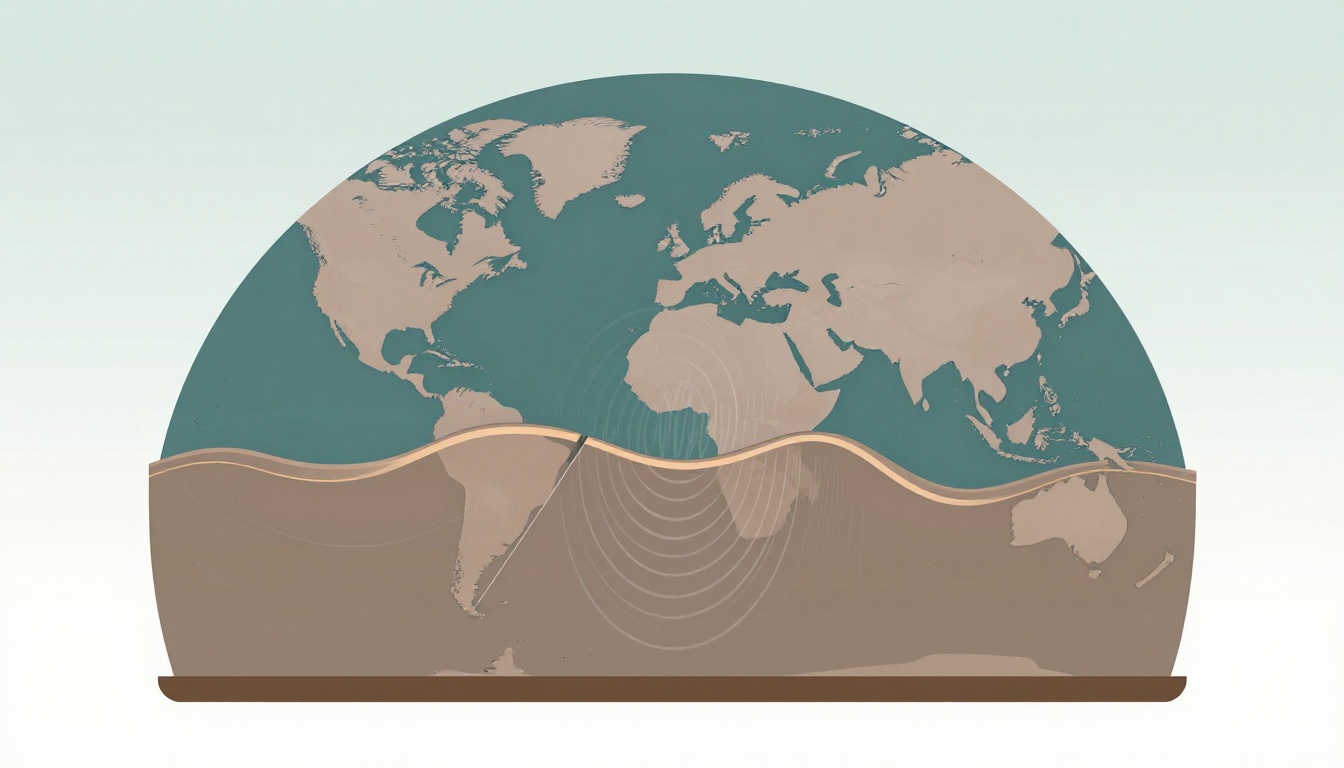
The ground can feel calm, then suddenly lurch like someone yanked a rug out from under you. That scary shake comes from earthquakes, and it happens more often than most people realize.
You might also wonder: if they happen so much, why do only some get noticed? Most earthquakes are small and occur far from people. Still, the big ones can be deadly, because shaking can damage buildings, bridges, and roads.
At the heart of what causes earthquakes is a simple idea. Stress builds underground, rocks slip along a crack (a fault), and energy bursts out as seismic waves. Next, we’ll connect that process to where earthquakes happen, from plate boundaries like the Ring of Fire to quieter interior zones. Ready to uncover why the ground sometimes moves?
How Earth’s Massive Plates Build Up Earthquake Energy
Earth is wrapped in a thin, hard shell. It’s broken into tectonic plates. These plates move slowly, about as fast as your fingernails grow. They shift because hot material moves inside Earth’s mantle, like slow stirring in thick soup.
But plate motion does not mean constant sliding. Instead, many plate edges get stuck. Friction holds the rocks in place until stress becomes too much. Then the stuck section snaps and slips. The result is an earthquake, and seismic waves travel outward.
That’s the basic story, and it matches the U.S. Geological Survey’s explanation: earthquakes come from sudden slip on a fault, caused when stress overcomes friction. You can read the core version here: what causes earthquakes (USGS FAQ).
Think of a rubber band stretched between your fingers. For a while, it resists. Then it snaps back fast. Earthquakes work a bit like that. Stress builds gradually, then releases quickly.
Now, here’s where faults come in. A fault is a fracture zone where rocks can move. The most common earthquake-causing slip happens at plate boundaries. In fact, much of Earth’s seismic energy comes from these zones where plates interact.
To keep it straight, it helps to know the main fault types. They differ by how the rocks move:
- Strike-slip faults: rocks slide sideways, like the famous motion along the San Andreas Fault.
- Normal faults: the crust pulls apart, so one side drops down.
- Reverse (thrust) faults: one side pushes up as rocks compress.
If you’re a visual learner, picture a simple cross-section diagram showing these three motions. You’d see the “hinge line” where stress concentrates. Then you’d see it break when friction gives up.
Also, don’t assume earthquakes only happen on land. They happen under oceans too, and plate motion drives a lot of that activity. The American Museum of Natural History also explains how plate tectonics powers earthquakes in a clear way: plate tectonics and earthquakes (AMNH).

The Role of Faults in Snapping Rocks
If plates are the big moving parts, faults are the places where things actually slip. A fault forms where rock layers break or weaken over time. Over years, decades, and centuries, stress keeps building.
Here’s the key mechanic: rocks do not glide smoothly under pressure. Instead, they stick at first. Then the stress level climbs. Eventually, the stuck patch reaches a point where it cannot hold anymore. At that moment, the rocks rupture and slip, releasing energy as seismic waves.
This is why the “same region” can produce multiple quakes. Once a fault slips, stress redistributes. Some areas relax, while other sections get loaded. So the fault can break again later.
Faults also explain why quakes can happen at different depths. Most shallow quakes happen close to Earth’s surface, where rock is brittle and fractures easily. Deeper quakes can form hundreds of kilometers down, where pressure and temperature change how materials behave. In those cases, scientists suspect mineral changes help create conditions that allow rupture.
For a well-known example, the San Andreas Fault is often used for strike-slip motion. Along strike-slip faults, two sides move past each other. That sideways motion makes long, winding fault traces visible on Earth’s surface over time.
So, when you hear “a fault ruptured,” it’s not just wording. It means the ground shook because rock along a crack zone suddenly moved.
In short, earthquake causes often come down to this: friction holds, stress grows, then the fault snaps.
Less Common Triggers Like Volcanoes and Human Activity
Plates and faults handle most earthquakes. Still, other forces can trigger smaller shakes.
Volcanic quakes
Volcano regions can produce earthquakes, even when tectonic stress is not the main trigger at that moment. Magma moves underground. As it rises and pushes into cracks, it stresses surrounding rock. That stress can cause earthquakes, usually near volcanic systems.
Landslides and collapses
Not every quake comes from tectonic slip. When slopes fail, rock can tumble and create seismic waves. The shaking may resemble an earthquake, even though the source is a collapse.
Induced earthquakes
Humans can also affect the ground. These are often called induced earthquakes. Common triggers include:
- fracking (especially if pressure changes reach faults),
- wastewater injection (which can raise pressure in rock pores),
- reservoir filling behind dams,
- and other activities that alter underground fluids.
The U.S. Geological Survey has dedicated resources for this topic, including an overview of how induced seismicity happens: induced earthquakes overview (USGS).
It’s important to stay calm here. In many places, induced quakes remain small. Still, risk depends on local geology, pressure buildup, and how close vulnerable faults are. Scientists also study how pore pressure can speed up slipping on faults, which is why monitoring matters.
Mapping the Shakiest Places on Earth
So where do earthquakes happen? In general, you’ll find them where tectonic plates meet. Many researchers estimate that more than 80% of earthquakes occur along plate boundaries.
To spot patterns, look at Earth’s major tectonic “edges.” Some edges form trenches, where one plate sinks under another. Other edges spread apart, forming rifts. Still others slide sideways, generating long fault lines.
If you want a mental map, imagine seams wrapped around the planet. Those seams show where plates interact. Now, add a bright hotspot area around the Pacific Ocean, and you’ve got the setting for most big quake news.
One reason plate boundaries dominate is energy. Where plates collide, slide, or pull apart, stress concentrates and faults are ready to slip.
Here are several key regions you’ll see often when people ask where earthquakes happen:
- Japan and the Kuril Islands, where oceanic plates subduct
- Indonesia and the Philippines, with multiple subduction zones
- Alaska and the Aleutians, with frequent offshore quakes
- Western North America and Chile, linked to subduction along coastlines
- The Himalaya region, driven by continent-to-continent collision
- Mid-ocean ridges, where new crust forms and spreads
At the same time, earthquakes can occur inside plates too. Those are usually less frequent, but they can still be strong.
To help connect the dots, the USGS has a clear page on the Ring of Fire, the most quake-active band on Earth: the Ring of Fire (USGS).

Why the Ring of Fire Dominates Quake News
The Ring of Fire is a wide horseshoe-shaped belt around the Pacific Ocean. It’s packed with trenches, volcanoes, and faults. That’s because oceanic plates often sink under nearby plates in subduction zones.
When one plate subducts, the sinking slab drags down. It also helps pull and bend the plate edges. As the geometry shifts, stress builds along faults in the crust and in the deeper slab.
A common reason people connect Ring of Fire quakes to major damage is simple: subduction zones can produce large rupture areas. Big ruptures release a lot of energy.
Meanwhile, the same subduction setups can generate tsunamis, especially when seafloor displacement is large. So even if you don’t see a fault line on land, the sea floor can store and release energy.
Examples that often show up include quakes near Japan and Indonesia. Those regions sit right on top of active subduction, so strong shaking is more likely.
In short, Ring of Fire earthquakes dominate headlines because the belt contains many fault-ready zones, and some of those zones can rupture over big areas.
Hidden Dangers Inside Stable Plates
Quakes inside “stable” plates sound less likely, but they can still happen. These are often called intraplate earthquakes. They occur away from plate boundaries, usually in regions with old faults or leftover stress.
A famous example in the United States is the New Madrid seismic zone in the central U.S. It sits far from active plate boundaries. Yet strong earthquakes have occurred there in the past, and the region still needs attention.
So what triggers intraplate events? Scientists think a few factors can work together:
- ancient faults that never fully healed,
- stress transfer from plate movements elsewhere,
- and changes in how rock breaks under long-term pressure.
Because these zones are less studied than active boundary zones, people sometimes underestimate the risk. Buildings may not be designed for local shaking. However, hazard maps and updated building codes can still improve protection.
What Science Tells Us About Predicting and Surviving Quakes
A lot of people ask a hopeful question: can we predict earthquakes? Right now, the answer is no for exact timing. You cannot reliably say, “This quake will happen tomorrow at 3:12 p.m.”
However, science can help in other ways.
Early warning instead of long-range prediction
Early warning systems use the fact that seismic waves do not all travel at the same speed. When the first waves arrive, systems can sometimes detect them and send alerts before stronger shaking reaches faraway areas.
These alerts do not prevent earthquakes. They give people seconds or a short time window to take action. That window can help reduce injuries during the moments when you’d otherwise freeze.
What recent research focuses on
Recent work aims to improve risk mapping, faster models, and better sensing. For instance, researchers keep refining how underground structure affects shaking. In addition, fiber-optic sensor methods can pick up ground motion patterns. Then, AI systems may help interpret that motion quickly enough for warning decisions.
Still, these advances support preparedness, not fortune-telling.
Earthquake stats that put risk in perspective
In late March 2026, Earth saw about 15,000 earthquakes per month on average. Most were small, and most were too far away to matter to daily life.
Meanwhile, bigger events still happen. The same period included notable quakes, including a 7.3 magnitude event near Vanuatu reported in late March. That’s a reminder that shaking can be widespread, even when global activity feels “low” overall.
For day-to-day planning, the best next step is local awareness. The USGS has research-based hazard information for the U.S. too, including mapping of where damaging shaking is most likely: USGS map of damaging earthquake areas.

Surviving what you can control
You can’t stop the ground from moving, but you can reduce harm.
If shaking starts, follow simple safety moves:
- Drop to the ground,
- Cover under sturdy furniture,
- Hold on until shaking slows.
Also, prepare ahead of time. Keep an emergency kit, know where gas shutoff valves are, and secure heavy items. Building stronger matters too, especially in areas with higher hazard.
Finally, don’t ignore local updates. Earthquake risk can vary by neighborhood, not just by state.
Conclusion: Understanding earthquakes without the fear
Earthquakes happen when stress builds along faults and the stuck rocks suddenly slip. That process connects directly to plate motion, so most quakes cluster along plate boundaries, especially the Ring of Fire.
At the same time, other triggers exist. Volcanoes, landslides, and induced earthquakes can contribute, but tectonic stress remains the main driver.
Even though earthquake prediction for exact times isn’t possible yet, early warning and better hazard maps can help you respond faster. So when the hook in the opening story hits, you’ll know what’s happening under your feet.
Understanding shakes the fear away. Ready to uncover why the ground sometimes moves, and how to be ready when it does?