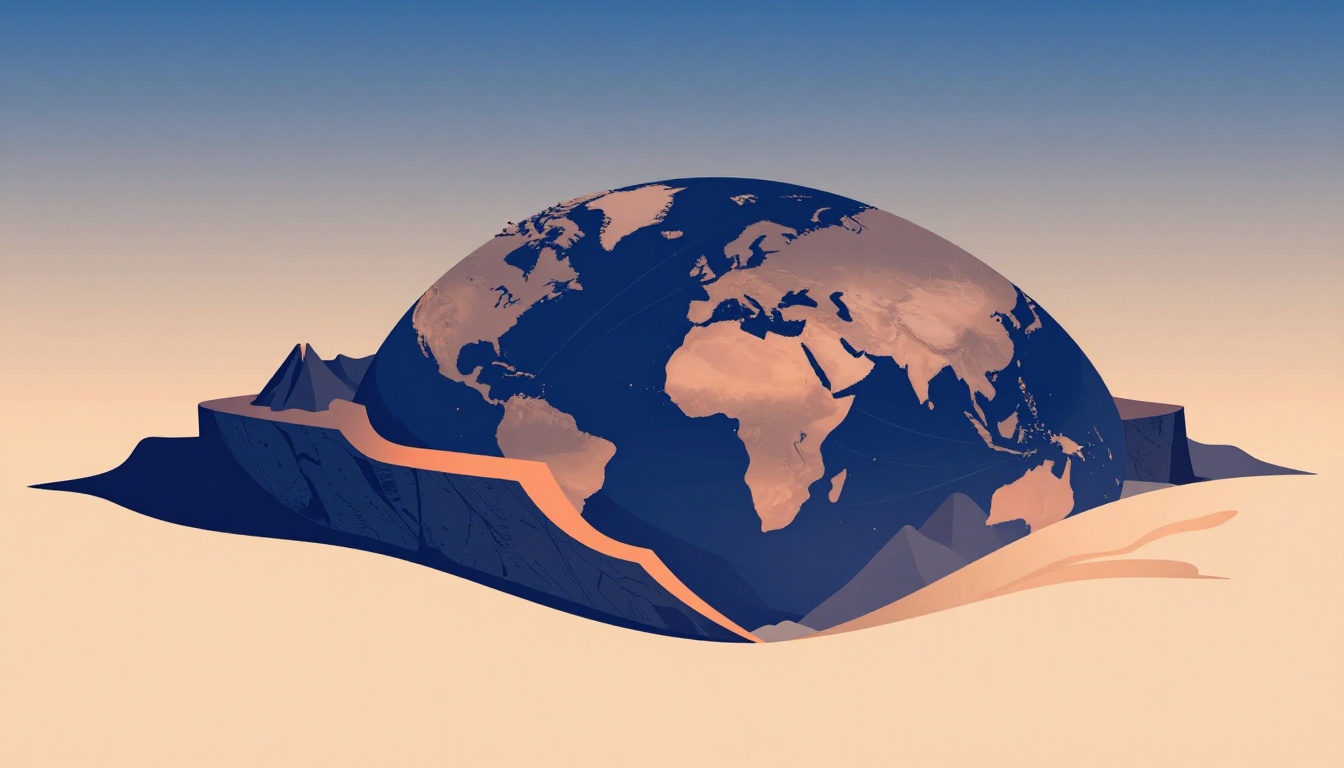
Imagine standing atop a massive mountain and wondering how it got there from mostly flat land. Mountains don’t pop up overnight. They build slowly, because Earth’s crust is always moving.
In most cases, the main causes are tectonic plates that squeeze, stretch, or dive. Volcanoes can add new rock too. Then, erosion chips the mountains back down, shaping what you see today.
In the sections ahead, you’ll get a simple breakdown of the main mountain types, with real examples like the Himalayas and Hawaii. You’ll also see how today’s research shows mountain growth is still happening.
Earth’s Tectonic Plates: The Force That Builds Mountains
Earth’s outer shell isn’t one solid piece. It’s broken into big slabs called tectonic plates. They float on hotter, softer rock below them, called the mantle.
Think of the plates like giant puzzle pieces on a warm, moving surface. When two pieces meet, the crust can buckle, break, or sink. That motion drives mountain building over millions of years.
Most mountain formation happens near plate boundaries, where plates interact. There are three key boundary types:
- Convergent boundaries: plates push together. This often causes uplift and folding.
- Subduction zones: one plate dives under another. This can create volcano chains.
- Divergent or rifting areas: plates pull apart. This can form faults and tilted blocks.
If you want a clear, kid-friendly visual guide, the AMNH explanation of mountain building and plate tectonics is a solid place to start.

In the real world, mountains usually form from a mix of processes. Still, four big categories explain most of what you see on maps.
| Mountain type | Main plate process | What it looks like |
|---|---|---|
| Fold mountains | Plates collide and compress | Long ridges, buckled rock layers |
| Volcanic mountains | Subduction melts rock | Volcano chains near trenches |
| Fault-block mountains | Crust stretches and breaks | Steep faces next to deep valleys |
Next, let’s break down each type with a simple “what happens first” story.
Fold Mountains from Colliding Plates
Fold mountains form when two land areas collide and push rock upward. In other words, you get crushing pressure, not just a gentle bump.
Start with two continental plates. Both plates are made of thick, buoyant crust. Because they’re similar in density, one plate usually can’t easily dive under the other. Instead, the crust crumples and shortens.
Picture an accordion being squeezed. The layers fold, bend, and pile up. As the folds grow, the land rises into tall peaks and long ridges.

The Himalayas are the best-known example. They began forming when India collided with Eurasia tens of millions of years ago. The USGS overview of the Himalayas explains how the collision can force the crust upward because neither side subducts easily.
Here’s a fun way to connect this to what you can measure today: mountains like this still rise. Even Everest and the Himalayas keep growing by a few millimeters each year, based on GPS-style measurements and satellite tracking. Erosion also keeps working, but the pushing can still win for now.
Volcanic Mountains from Subduction Zones
Now switch to a different kind of boundary. At a subduction zone, an oceanic plate dives under a neighboring plate.
As the oceanic plate sinks, it carries water and sediments down with it. That changes the rock it hits. Then, part of the crust melts and forms magma. After that, magma can rise and erupt.
Over time, repeated eruptions stack layers of lava and ash. That’s how you get volcanic mountains. Often, these volcanoes line up in a curved arc, roughly parallel to the deep ocean trench.
The Andes are a classic example. Researchers have also tracked how subduction along the Andes has varied in time and space. If you want a broad plate-tectonics background that matches this setting, the Geological Society page on oceanic-continental subduction helps tie the pieces together.
In North America, volcanic ranges can also appear above subduction-related zones. The Cascade Range, including peaks like Mount Rainier, fits this pattern.
One more detail matters: volcanic mountains usually grow in bursts. Some years bring quiet activity. Other times, a major eruption builds new rock fast. Still, the overall trend happens over long time scales.
Fault-Block Mountains from Stretching Crust
Fault-block mountains form when crust stretches and cracks. This often happens during rifting, where plates pull apart.
Imagine pulling on both ends of taffy. The middle thins. Then it breaks. On Earth, that stretching can create steep faults.
When blocks of crust shift along those faults, some blocks tilt up. Others drop down. The up-tilted blocks become mountain ranges. The down-dropped zones often become deep valleys called grabens.
The Sierra Nevada in California is a well-known fault-block range. Its east face is steep, while the western side slopes more gently. A Sierra Nevada Geomorphic Province report describes it as a tilted fault block nearly 400 miles long.
In the Basin and Range region, you can see many alternating ridges and valleys. East Africa’s rift system shows similar stretching effects, even though it lies in a different part of the world.
So if fold mountains look like squeezed layers, fault-block mountains look more like broken and tilted pieces. The shapes can feel sudden, but the buildup still takes ages.
Hotspots and Erosion: Other Ways Mountains Take Shape
Plates are the main engine, but they’re not the only one.
First, there are hotspots. A hotspot is a long-lasting upwelling of hot rock from deeper inside Earth. It can punch through the crust like a blowtorch. As a plate moves over that hot spot, volcanoes form in a line.
That’s why Hawaii makes sense. The oldest islands are farther from the current volcanic activity, and the chain lines up with plate movement. The Khan Academy video on Hawaiian islands formation is a quick way to see this hotspot idea in motion.

Next comes erosion, which is just as important as uplift. Once land rises, wind, rain, and ice start reshaping it. Rivers cut valleys. Glaciers grind down slopes. Gravity helps everything move downhill.
Over time, erosion can expose fresh rock layers and sharpen ridges. That means mountains can look “older” even if the crust is still changing.
Studies in the southern Appalachians show how erosion rates can vary across steep escarpments. For example, the Geology Society of America paper on erosion rates in the southern Appalachian Great Smoky Mountains helps explain how scientists measure landscape change.

Even in 2026, the big picture stays similar. Still, new seismic and mapping work keeps refining details. For example, recent studies use earthquake vibrations to better trace how parts of the Rocky Mountains formed, not as one simple step, but through shifting and stacking under the crust.
Famous Mountain Ranges and What They Reveal
Different ranges show different stories, but they all tie back to plate motion.
- The Himalayas: ongoing collision between India and Eurasia. That’s fold mountain building in action.
- The Rockies: complex uplift tied to plate interactions and crustal structure. Recent seismic research keeps adding clarity.
- Hawaii: hotspot volcanism on a moving plate. You can literally watch the chain pattern in maps.
Mountains also matter beyond scenery. They affect weather, because air rises over peaks and drops rain on one side. They can also create many habitats in a small space, which supports biodiversity.
What should you keep in mind for your next hike? Look at the shape. If you see long, crumpled ridges, think compression and folding. If you see a line of peaks near a former trench area, think subduction and volcanoes. If you spot steep walls and nearby valleys, think fault-block tilting.
As you travel, you’re not just moving through land. You’re moving through time, because mountains are still changing under your feet.
Conclusion
So, how are mountains formed? Most of the time, tectonic plates do the heavy lifting: collisions build fold mountains, subduction makes volcanic arcs, and stretching creates tilted fault blocks.
Then hotspots can add new volcanic rock, while erosion carves and sharpens the final shapes. Put it together, and mountains are living geology.
Next time you see a rugged skyline, remember it’s not finished. It’s still being built and worn down, day by day, storm by storm.
Which mountain range do you want to learn about next, and what feature stands out most to you?